History and Architecture of the Chacchoben Ruins
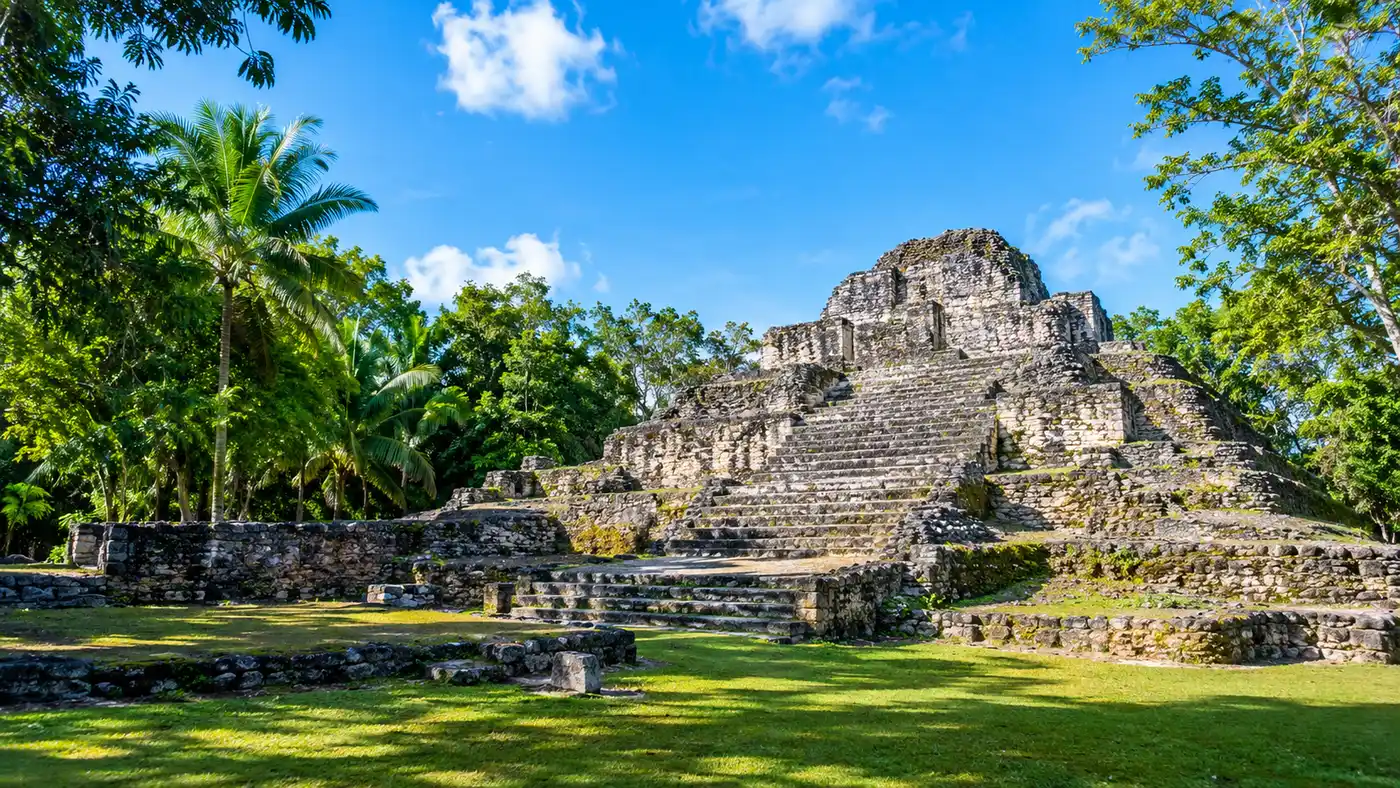
Deep in the quiet forest of southern Quintana Roo, massive grey stone mounds rise straight out of the red clay soil like sleeping giants. Long before tour buses from the coast began pulling up along the dusty access road, this place was known to local farmers simply as the place of red corn. Understanding the chacchoben mayan ruins history means stepping back into a world where dense tropical jungle met ambitious human engineering over two thousand years ago. The ruins feel different from the flat, baking plazas of the northern Yucatán.
Here, massive cohune palms canopy the stone, their thick fronds cutting out the harsh midday glare and casting moving shadows across wide staircases. Howler monkeys swing through the zapote canopy above, roaring when thunder clouds roll in from the Caribbean coast. You walk on packed earth trails between structures that are still half-swallowed by ficus roots, listening to cicadas whine in the midday heat. The story of this site is one of early settlement, dramatic architectural shifts, complete abandonment, and a curious mid-century rediscovery by an accidental homesteader.
Book your chacchoben mayan ruins experience:
The Deep Roots and Chacchoben Mayan Ruins Age
Human beings first cleared patches of forest around these freshwater lagoons around 200 BC. That puts the earliest chapter of the site firmly into the Late Preclassic period. People came here because of the water. Southern Quintana Roo is full of seasonal bajos and inland lagoons, which gave early farmers reliable drinking sources and rich silt for planting maize, beans, and squashes. For a long time, the settlement stayed small and modest.
The real explosion in size happened centuries later. When visitors ask about the chacchoben mayan ruins age, archaeologists usually point to the Classic period between 300 and 700 AD. That was the era when the modest village transformed into a major ceremonial center covering roughly six square kilometers. During these four centuries, stone carvers, laborers, and architects hauled thousands of tons of limestone up from nearby quarries to construct sprawling civic platforms.
Pro tip: Bring bug spray with high deet or picaridin content; the jungle shade keeps mosquitoes active all day, especially near the dirt paths leading back to Structure 24.
Pottery shards pulled from the lowest strata show strong ties to northern Belize and the Petén basin across the modern Guatemalan border. These early inhabitants were not isolated forest dwellers. They were part of a wide trading web that shuttled black obsidian from the volcanic highlands, jade beads, dried fish from the coast, and bright quetzal feathers. When political tensions boiled over in the central lowlands, Chacchoben felt the ripples. By the time 1000 AD rolled around, the major construction had stopped. The temples slowly went quiet, though local Maya continued to make pilgrimages here, leaving small incense burners and ceramic offerings on decaying stairways for centuries after the ruling priests disappeared.
The Gran Basamento and Sacred Architecture
The architectural highlight of the entire site is an elevated plaza known as the gran basamento. Instead of building temples right on the jungle floor, the Maya leveled an entire limestone ridge, building a massive artificial terrace that lifted their ceremonies dozens of feet above ordinary daily life. Climbing the central staircase to reach this upper court was meant to feel like ascending to the realm of the sky gods.
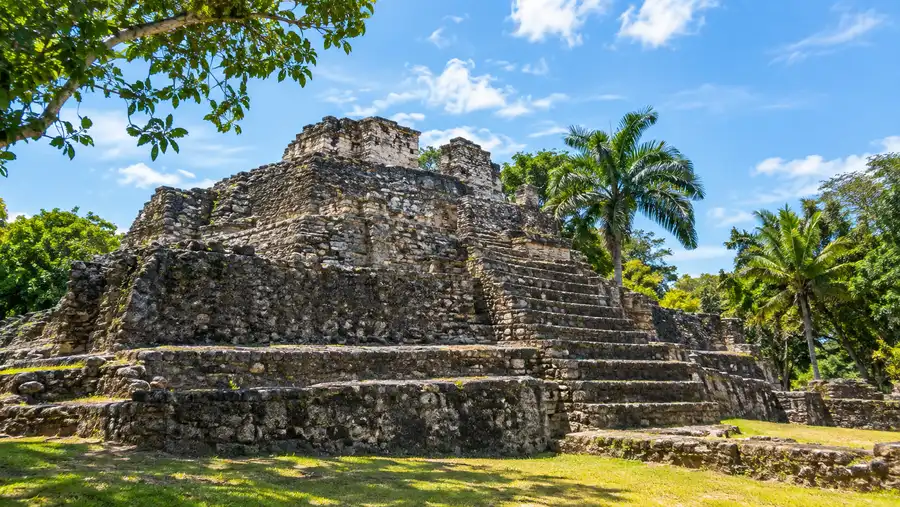
Once you reach the top of the wide platform, you are standing before Temple One, also called the Temple of the Vessels. This is the tallest pyramid at the site, topping out around 14 meters above the terrace floor. It dominates the clearing with rounded corners and stepped tiers that slant back sharply. Every temple at chacchoben mayan ruins displays elements borrowed from the Petén style of architecture. That style is famous for its massive apron moldings - stone cornices that hang down over the sloped walls like heavy fabric folds.
| Structure Name | Primary Date | Height / Footprint | Key Architectural Feature |
|---|---|---|---|
| Gran Basamento | 350 - 550 AD | Raised terrace over 100m wide | Massive limestone fill leveling natural ridge |
| Temple One (Vessels) | 400 - 600 AD | 14 meters tall | Rounded corners, steep apron moldings |
| Structure 24 | 300 - 450 AD | 12 meters tall | Two-tier stairway, central altar base |
| Plaza B Group | 500 - 750 AD | Sprawling low platform | Residential elite rooms, private courtyards |
Architects here knew how to create drama. The staircases are steep, with steps so shallow from front to back that you have to turn your feet sideways to climb them safely, though visitors are kept off the stone nowadays to prevent wear. That steepness was deliberate. It forced priests to walk upward in a rhythmic, zigzag fashion, turning their bodies in profile so spectators gathered on the plaza floor below could see every move of their feathered headdresses against the bright tropical sky.
Rediscovery and What Lies Under the Mounds
Chacchoben vanished under dense jungle growth for roughly seven hundred years. It stayed hidden until 1942, when a local Maya farmer named Serviliano Cohuo was looking for good farming land to establish a milpa. He hacked his way through the vines and stumbled upon massive stone hills. Instead of reporting them to the government, Cohuo did something remarkable: he built a small wooden homestead right on top of the ruins, planted fruit trees, and lived peacefully among the ancient stones for thirty years.
It was not until 1972 that an American archaeologist, Dr. Peter Harrison, saw the mounds from a small survey aircraft while working on a regional mapping project. Harrison made contact with Cohuo, mapped the main structures, and notified the Mexican National Institute of Anthropology and History (INAH). Formal excavation did not actually get off the ground until 1994, which makes Chacchoben one of the most recently excavated public sites in the entire state of Quintana Roo.
Note: Climbing the pyramids has been forbidden since 2005 to preserve the soft limestone steps and prevent accidents on the slick surface.
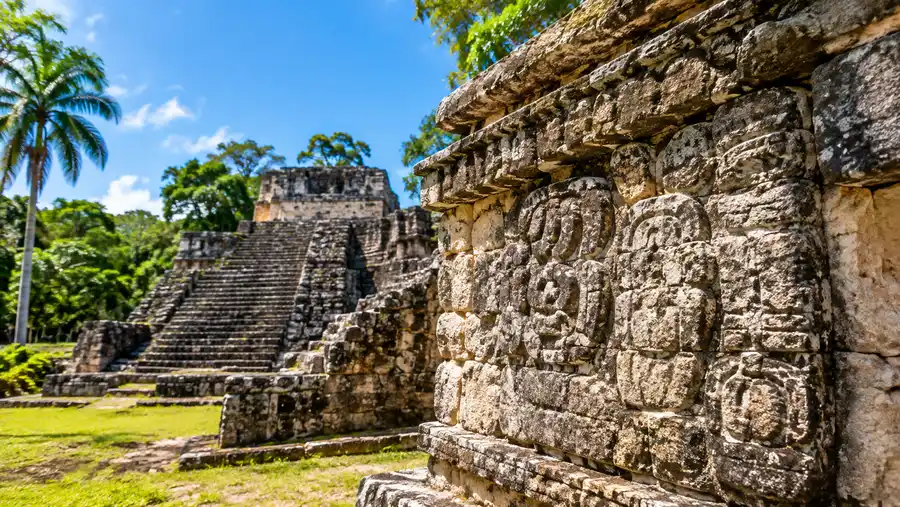
Archaeologists working the trenches quickly discovered that the visible facades are only the outer shell. Finding older mayan ruins inside newer ones is standard practice across Mesoamerica, and Chacchoben is a textbook example. Whenever a new ruler took power, or a major cosmic calendar cycle completed, workers did not knock down the old temple. They encased it in tons of limestone rubble, mortar, and new cut stone, building a bigger pyramid directly over the top of the sacred original. Deep ground-penetrating radar and test shafts have revealed earlier Preclassic shrines resting untouched deep in the belly of the main pyramids.
Book your chacchoben mayan ruins experience:
Decoding the Stone: Red Stucco and Petén Style
When you stand back to compose your chacchoben archaeological zone photos, you are looking at grey, weathered stone. That is not how it looked to the people who prayed here. During the height of the Classic period, almost every square foot of exposed limestone was covered in a thick layer of smooth lime stucco and painted bright, saturated scarlet. Red was the color of the east, the rising sun, blood, and life itself.
If you look very closely under the overhanging cornices on the west face of Structure 24, you can still spot faint, stubborn patches of original red pigment clinging to the rock. Workers made the paint by grinding hematite and cinnabar into fine powders, mixing them with tree sap and water. Imagine rounding a jungle trail fifteen hundred years ago and seeing a towering red mountain rising out of the green forest canopy, framed by white limestone plazas and smoking copal resin censers. It must have looked electric.
The builders also relied on several architectural trademarks that set Chacchoben apart from northern sites like Chichen Itza:
- Apron moldings: Recessed lower wall panels that create deep shadow lines across the facade on sunny afternoons.
- Curved pyramid corners: Softened edges on each terrace tier, which helped distribute structural weight and echoed Petén construction practices.
- Superimposed platforms: Staggered base levels that allowed priests to conduct rituals at different elevations depending on the ceremony.
- Astronomical sightlines: Buildings oriented deliberately to track the winter and summer solstices, aligning sunrise directly through key doorway portals.
The city planners aligned these stones with absolute purpose. During the equinoxes, the morning sun clears the horizon and casts clean horizontal bands of light across the upper temple terraces, marking the exact moment for farmers to burn their fields or drop corn seed into the dry soil before the rains arrived.
Visiting the Site Today: Exploring the Ruins in Person
Visiting Chacchoben feels remarkably peaceful compared to the mega-sites up north. The Mexican government cleared only a small percentage of the settlement area, leaving about 70 percent of the structures buried under thick humus, ficus trees, and bromeliads. You can see giant, unnatural green hills sitting right next to the cleaned pyramids, giving you an immediate sense of how the jungle swallows human civilization when given enough time.
A typical walk through the site covers a winding, mostly flat trail of crushed stone about a mile long. You start at the main entrance circle, pass through the low walls of the Plaza B residential quarters, and emerge at the foot of the dramatic Gran Basamento. The walk takes roughly an hour and a half if you move at an easy pace and stop to read the information boards.
- Morning light: Arrive before 10:00 AM if you want clean lighting for wide-angle shots of the main temples without crowds in the frame.
- Footwear choice: Wear closed-toe shoes with good grip; exposed tree roots and mossy pavers get extremely slick after a brief tropical shower.
- Local guides: Hire an authorized INAH guide at the ticket gate for roughly $40 to $50, as they point out hidden stucco details you will definitely walk right past.
- Hydration needs: Southern Quintana Roo humidity sits near 80 percent most mornings, so carry at least a liter of water per person.
Honestly, the best spot to pause is the quiet grove of ramon trees between Plaza B and Temple 24. If the tour groups from the cruise ships have not arrived yet, the only sound you hear is the heavy thud of ripe fruit dropping onto the jungle floor and the clicking calls of green parrots overhead. It feels wild, untouched, and properly old in a way manicured archaeological parks rarely manage to preserve.
Frequently Asked Questions about chacchoben mayan ruins history
How old is Chacchoben really?
The earliest village settlement dates to approximately 200 BC, but the grand pyramids and plazas you see today were constructed between 300 and 700 AD during the Maya Classic era.
Who discovered Chacchoben?
A local Maya man named Serviliano Cohuo found the overgrown ruins in 1942 while searching for farmland. He lived among the temples until archaeologist Peter Harrison mapped the area in 1972.
Can you walk inside or climb the ruins?
No, you cannot enter the interior chambers or climb the pyramids. Visitors must remain on marked dirt pathways to protect the fragile ancient masonry from wear and erosion.
Quick Reference
- Location: Southern Quintana Roo, 45 minutes inland from Costa Maya
- Primary building era: 300 to 700 AD
- Main temple height: 14 meters (Temple of the Vessels)
- Excavation opened to the public: 2002
Book your chacchoben mayan ruins experience:
The Bottom Line
Chacchoben gives you a rare look at an ancient Maya ceremonial center that still belongs mostly to the jungle. The rounded stone corners, traces of red paint, and soaring platforms tell the story of a sophisticated society that mastered architecture, agriculture, and astronomy in a challenging forest environment. When you stand on the platform of the Gran Basamento and look out across the green canopy, it is easy to forget modern Mexico entirely and simply marvel at what human hands built here out of raw stone so long ago.
Read more about chacchoben mayan ruins.